



Overview
The Rose Cross is one of the clearest and potent paths of inner transformation in Steiner’s esoteric exercises. It belongs to the Rosicrucian stream that Steiner saw as essential for modern spiritual work.
The Rose Cross meditation can seem abstract, but in practice, it is very practical. Steiner never treats it as a symbol to admire from a distance or to look at symbolically, but instead as a living picture that awakens forces that are already present in the human being. If it's done properly, it can be one of the easiest ways to get on (or boost your existing path on) the road to spiritual development.
What is the Rose Cross?
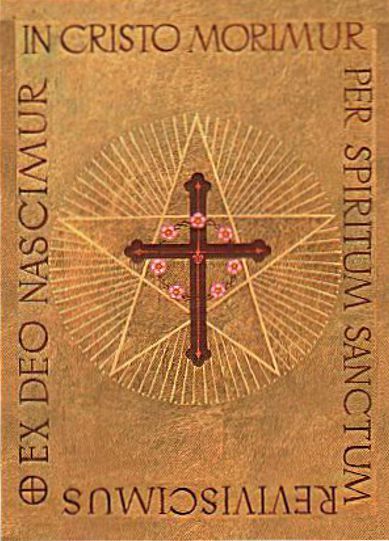
The Rose Cross is a very old Rosicrucian symbol: a black cross surrounded by seven roses. There's much more to look into there but we'll leave it for now.
Black Cross with Red Roses
The black cross with red roses is, basically, the beginning.
The pure black of the cross, used in the traditional archetypal sense of the colour, represents what in the human being must be allowed to die; impulses of personal desire, instinct, egotism, and unshaped emotional reactions. The stuff that keeps the soul tied to a lower level of life.
The roses are red, the colour of living blood. They represent the life forces that have been spiritualised or purified, what must arise from the transformation of the lower self.
This form of the symbol is a symbol of becoming; the human being who consciously shapes their life forces instead of being carried along by them.
White Cross with Green Roses
The higher form of the meditation appears only after the first is well-established. At that stage the symbol changes: the cross becomes white, and the roses become green. Green is the colour of growing life, now spiritualised; white is the pure, clarified nature of the higher self. This picture belongs to a later stage, when the soul begins to feel itself connected to the wider macrocosm.
Beginners should work with the black cross and red roses. The white-green Rose Cross is not a second technique but the same meditation naturally changedthrough experience.
How to Practice the Rose Cross Meditation
Begin by sitting quietly. A few minutes of breathing or settling the body is helpful, but not mandatory. The meditation is imaginative, not physical.
Gently bring before your mind the picture of a plant. A simple one is best. See it growing from the soil, forming leaves, rising toward the light, blossoming. Let the picture be clear, calm, and without strain. The plant grows by necessity. It is pure, orderly, and shaped entirely by the forces of the cosmos.
Then bring into view the image of a human being beside it. The human is more complex, more free, and capable of self-awareness, but also carries tendencies the plant does not; passions, desires, impulses that rise and fall. Where the plant follows a lawful rhythm, the human being has to work consciously on its inner life.
From this understanding, then imagine the symbol.
Imagine a simple wooden cross, dark or black, A picture of what you are consciously overcoming. The black cross is the part of your being that becomes still, no longer driving or clouding your inner life.
Upon this cross, picture a wreath or cluster of seven red roses. They should feel alive, warm, growing. The roses represent the life forces that are purified, awakened, and offered freely. This is basically a living symbol of the victory of the higher nature over the lower, through transformation.
Let the picture rest in your soul. Do not force meaning into it. Over time, the picture becomes less like something you imagine and more like a state of soul you enter.
Steiner emphasises that the meditation only works when approached with sincerity of feeling and a willingness to transform one’s motives. It is not an aesthetic exercise. The picture is effective because it corresponds to real processes in the human being (GA 115).
This is the black cross and red roses meditation.
If practiced steadily, something eventually shifts. At a certain point, Steiner says, the cross becomes white and the roses green.
This is described in GA 265. It marks a stage where the soul begins to feel itself woven into larger forces, no longer working only on personal transformation but entering a sense of participation in spiritual activity.
There is no hurry toward this second form. The black cross and red roses are already complete in themselves and belong to the essential Rosicrucian training Steiner gave.
Working With the Meditation Day to Day
The Rose Cross does not require long sessions. A few minutes of calm, clear imagination is enough. What matters is regularity and purpose.
If you want to read more about the rose cross meditation, or read the original texts refrencing it, see the link below.



Discussion